Introduction
Deep in the lush, forest-covered hills of southern Gujarat lies Dang — the state’s only district with a predominantly tribal population. Once a year, this quiet region transforms into a vibrant cultural and political center during the Dang Darbar.
To outsiders, it may look like a colorful tribal festival held around Holi. But that’s only the surface. Dang Darbar is a rare historical continuation of a royal-political tradition that began during British rule and still survives in modern India.
If you want to understand real tribal Gujarat — not the postcard version — you need to understand Dang Darbar.
Historical Origins: A Colonial Legacy That Never Ended
Dang Darbar began in the 19th century under British administration. The Dang region was ruled by five tribal chiefs (often referred to as “Rajas”). When the British wanted access to the rich forests of Dang for timber and strategic purposes, they entered into agreements with these tribal rulers.
Under these agreements:
- The British recognized the authority of the tribal chiefs.
- In return, they were granted access to forest resources.
- An annual political meeting — called the “Darbar” — was held.
- The chiefs were given yearly allowances as part of the arrangement.
Unlike many colonial systems that disappeared after independence, this one did not vanish. After 1947, the Government of Gujarat continued the tradition. The annual gathering remains a formal event where tribal chiefs are still honored publicly.
This makes Dang Darbar historically unique — it is one of the few surviving ceremonial assemblies of tribal royalty in India.
Where and When It Happens
Dang Darbar takes place in Ahwa, the administrative headquarters of Dang district. The timing usually coincides with the Hindu festival of Holi, typically in March.
The combination of Holi celebrations and tribal gatherings creates an atmosphere that is intense, colorful, and deeply energetic.
The Five Tribal Rulers
Dang district historically consisted of five princely estates ruled by tribal kings. These chiefs, though not rulers in the conventional royal sense today, still hold ceremonial recognition.
During Dang Darbar:
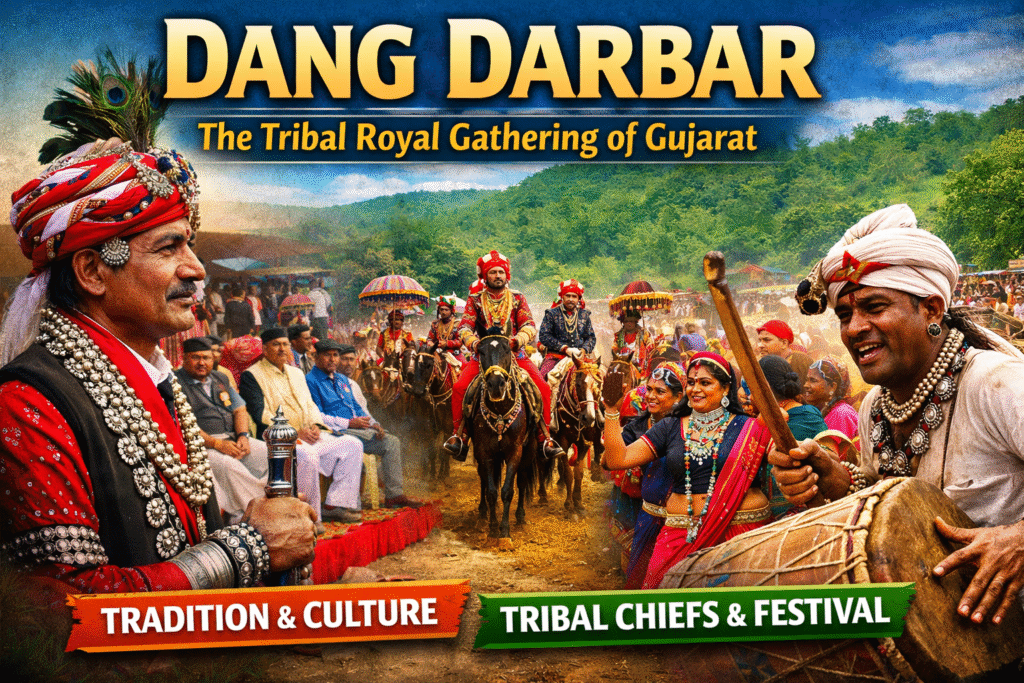
- The chiefs arrive in traditional attire.
- They participate in formal processions.
- Government officials share the stage with them.
- Symbolic honors and allowances are presented.
This ceremonial acknowledgment is not just tradition — it is political recognition rooted in history.
Cultural Performances: The Heartbeat of the Festival
4
The most visually striking part of Dang Darbar is the tribal dance and music.
What You’ll Witness:
- Large groups of men and women performing synchronized circular dances
- Rhythmic drum beats echoing through the hills
- Traditional bamboo instruments and folk songs
- Vibrant turbans, silver jewelry, and embroidered garments
The dances are not choreographed for tourism. They are community expressions passed down for generations. The movements are repetitive, powerful, and symbolic — often connected to nature, harvest cycles, and community bonding.
Unlike commercial festivals, this celebration feels raw and authentic.
The Mela (Fair) Atmosphere
Alongside the formal ceremony, a large fair develops around the Darbar grounds.
You’ll find:
- Local handicrafts
- Tribal ornaments and textiles
- Traditional food stalls
- Rural games and community gatherings
However, make no mistake — this is not a highly commercialized tourist fair. The crowd is primarily local tribal communities, with a growing number of photographers and cultural enthusiasts.
Political and Social Importance
Dang is one of Gujarat’s most forested and least urbanized districts. Tribal communities form the majority of its population. For them, Dang Darbar is more than celebration — it is identity validation.
It serves as:
- A platform for tribal representation
- A reminder of historical agreements
- A public recognition of indigenous leadership
- A symbolic bridge between government and tribal society
In a country where many tribal voices struggle for visibility, Dang Darbar stands as a structured acknowledgment of their presence and legacy.
Travel Perspective: What to Expect
If you plan to attend Dang Darbar:
- Expect large crowds.
- Accommodation in Ahwa is limited — plan early.
- Roads are scenic but rural.
- Photography opportunities are exceptional.
- Respect local customs — this is not a tourist performance show.
The natural beauty of Dang — with its dense forests and rolling hills — adds dramatic visual depth to the event.
Why Dang Darbar Still Matters
In modern India, rapid development often sidelines traditional communities. Dang Darbar resists that erasure. It preserves history, honors tribal leadership, and keeps cultural identity alive in a structured, public way.
It is not flashy like urban festivals. It is not aggressively promoted. But that is precisely why it matters.
Dang Darbar is not just a festival.
It is a surviving institution.
Conclusion
Dang Darbar in Ahwa is one of Gujarat’s most historically significant and culturally rich gatherings. Rooted in colonial agreements yet alive in contemporary governance, it represents continuity — a rare phenomenon in a rapidly changing world.
If you want to witness a festival that is both political and cultural, ceremonial yet deeply community-driven, Dang Darbar deserves your attention.
It is Gujarat beyond the cities.
It is history that still walks on stage every year.